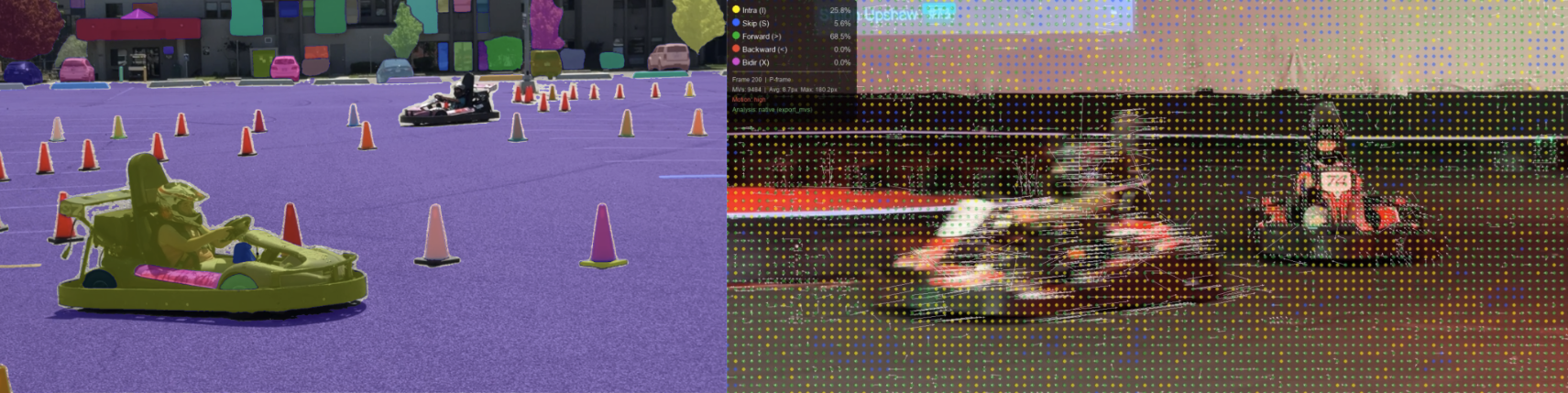
H.266/VVC (2020) targets another ~50% bitrate reduction over HEVC through multi-type tree partitioning, 67 intra modes, and adaptive in-loop filtering. Explore the innovations interactively.
H.266/VVC (Versatile Video Coding) was standardized in 2020, targeting the same quality as H.265 at half the bitrate.
Feature
H.265 / HEVC (2013)
H.266 / VVC (2020)
Max CTU size
64×64
128×128
Block partitioning
Quad-Tree (QT) only
Multi-Type Tree: QT + Binary (BT) + Ternary (TT)
Intra prediction modes
35 modes (33 angular + DC + Planar)
67 modes (65 angular + DC + Planar)
In-loop filters
Deblocking + SAO
Deblocking + SAO + ALF (Adaptive Loop Filter)
Transform types
DCT-II (4×4 to 32×32)
MTS: DCT-II, DST-VII, DCT-VIII (4×4 to 64×64)
Motion compensation
Advanced AMVP + merge
Affine motion + Geometric Partitioning Mode (GPM)
Screen content
Limited
Intra Block Copy (IBC) — reuse blocks from same frame
Bitrate efficiency
Baseline
~40–50% more efficient
Encoding complexity
High
10–20× higher than H.265
Hardware decode support
Widespread
Very early (2023+ chips)
Multi-Type Tree (MTT) Partitioning
H.265 can only split a block four ways (quad-tree). H.266 adds binary splits (2 equal halves) and ternary splits (¼ + ½ + ¼ rows/columns), letting the encoder align block boundaries with real content edges.
Why it matters: An H.265 encoder hitting a horizontal edge through the middle of a CTU must quad-split it — creating four blocks that all straddle the edge. H.266 can use a single binary-horizontal (BTH) split instead, cleanly placing the edge at the block boundary. Fewer, better-aligned blocks = less residual to encode = fewer bits.
45
H.265 — Quad-Tree Only
H.266 — Multi-Type Tree
H.266 split types:
Quad (QT)
Binary Horiz (BTH)
Binary Vert (BTV)
Ternary Horiz (TTH)
Ternary Vert (TTV)
—
H.265 leaf blocks
—
H.266 leaf blocks
—
Block reduction
—
Non-QT splits used
Intra Prediction Modes: 35 → 67
H.266 adds 32 new angular directions (filling the gaps between H.265's 33 angles), plus a PDPC (Position Dependent Prediction Combination) refinement applied to all modes.
The finer the angular grid, the better the prediction. With 65 directional modes (vs 33 in H.265), H.266 can match the actual direction of textures and edges almost perfectly, leaving a much smaller residual. PDPC further reduces the residual by weighting reference pixels by their distance to the predicted pixel.
Adaptive Loop Filter (ALF)
H.266 adds a third in-loop filter — a Wiener filter whose 7-tap diamond coefficients are optimized per-CTU to minimize reconstruction error. It targets the residual artifacts that deblocking and SAO leave behind.
How ALF works: After decoding, the encoder signals a small set of filter coefficient vectors. The decoder applies the best-matching filter to each CTU's luma and chroma samples. Because coefficients are signaled in the bitstream (a few hundred bits per frame), they can adapt to whatever artifacts the current frame's compression produces — something fixed deblocking and SAO cannot do.
5
Original
H.265 (Deblock + SAO)
PSNR: —
H.266 (+ ALF)
PSNR: —
—
ALF PSNR gain
—
Artifact reduction (MSE)
Deployment Status & When to Use Each
H.266 is technically superior but has very limited hardware and software deployment as of 2026. Choose carefully.
Stick with H.265 when…
Targeting consumer devices — H.265 hardware decode is near-universal
Live or near-live encoding (H.266's complexity is prohibitive for real-time)
Using Apple, Android, or smart TV delivery pipelines
Licensing clarity is important (H.266 has the same fragmented patent pool issue as H.265, compounded)
Your CDN / player stack doesn't support H.266 (almost all of them, today)
4K/HDR streaming — H.265 is already efficient enough for most delivery
Consider H.266 when…
Archiving masters for future re-delivery — storage savings compound over time
Encoding is offline, one-time, and cost-per-hour is acceptable
Targeting controlled endpoints with known H.266 decode support
8K delivery where bandwidth is the hard bottleneck
Screen-recording / gaming content (benefits from Intra Block Copy)
Research, standards testing, or codec benchmarking
Real-world context (2026): Software decoders (VVdeC, FFmpeg libvvdec) exist but are not bundled in browsers or OS media frameworks. Hardware decode is available in select 2023+ SoCs (e.g., some MediaTek, Samsung Exynos chips). Practical H.266 deployment remains niche. For royalty-free alternatives at comparable efficiency, AV1 (2018) has broad browser and hardware support today, and AV2/AVIF2 is in development.